

Reality Is a Controlled Hallucination: Inside the Predictive Brain- Issue #30

“Perception is not something that happens to us, or in us. It is something we do.”-Alva Noë, Action in Perception (2004)
Every moment, your brain is not merely receiving the world, it is predicting it.
From the color of the wall to the weight of a cup, every perception begins as a hypothesis, tested and updated in real time. This framework, known as predictive coding or predictive processing has become one of the most influential theories in modern neuroscience (Friston, 2010; Clark, 2013).
At its core, predictive coding suggests that the brain is a generative model, a self-updating simulation that continuously forecasts incoming sensory inputs and adjusts when its expectations don’t match reality. The result? What we experience as “perception” is the brain’s best guess of the world, continuously corrected by sensory evidence.
In short: perception is prediction constrained by sensation.
This framework extends beyond vision or hearing. It explains how we move, feel emotions, make decisions, and even experience a stable sense of self.
The Neuroscience of Prediction and Error
Cortical Hierarchies and Feedback Loops
Predictive coding proposes a hierarchical structure in the cortex. Higher regions generate top-down predictions, while lower regions send back bottom-up prediction errors, the difference between expected and actual input (Rao & Ballard, 1999).
Every cortical level communicates in this loop. When errors are small, the brain’s model is accurate. When large, it updates its beliefs. Over time, this loop allows the brain to minimize surprise, what Karl Friston calls the Free Energy Principle (Friston, 2010).
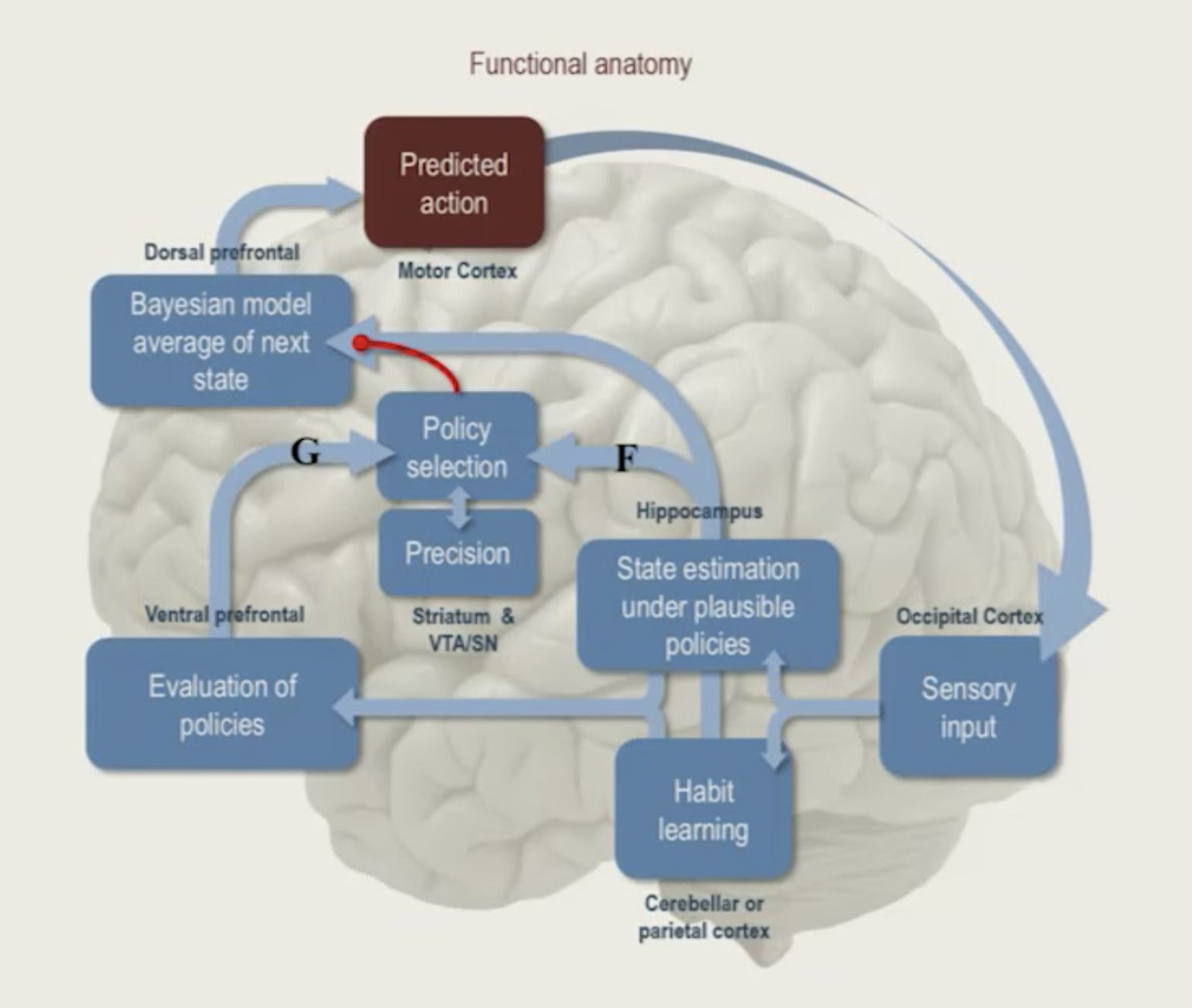
Experimental Evidence: The Brain’s Prediction Errors
Evidence for predictive coding comes from multiple well-established paradigms:
Mismatch Negativity (MMN): EEG studies show a negative deflection around 100–250 ms after an unexpected auditory event, the brain’s automatic detection of a violated sensory regularity (Näätänen et al., 2007). In predictive-coding terms, the MMN represents a prediction-error signal, generated when actual input deviates from the brain’s statistical model of the environment.
Error-Related Negativity (ERN): A rapid negative EEG deflection originating in the anterior cingulate cortex (ACC), the ERN peaks ≈ 50–150 ms after an error, often before conscious awareness (Gehring et al., 1993). It marks the brain’s automatic performance-monitoring signal, interpreted as either a negative prediction error (“worse than expected”) or conflict between competing actions, prompting swift behavioral correction.
Perceptual Illusions: The McGurk effect, hollow-mask illusion, and bistable figures demonstrate that perception follows internal models more than raw input (Hohwy et al., 2008). When data are ambiguous, the brain privileges priors — top-down expectations, over conflicting sensory evidence.
Sensory Attenuation: During self-generated movement, predicted sensations are suppressed, explaining why you can’t tickle yourself (Blakemore et al., 2000). This reflects a forward model that subtracts expected sensory consequences from self-produced actions.
Together, these findings reveal a simple truth: the brain does not passively receive the world, it continuously predicts it, corrects itself, and thereby constructs the stable experience of reality.
Beyond Sensation: Prediction in Emotion, Action, and Self
Predictive processing extends deep into interoception, the brain’s monitoring of internal bodily states.
Emotion as Prediction: According to Lisa Feldman Barrett’s Theory of Constructed Emotion, emotions are the brain’s predictions about bodily states, not mere reactions (Barrett, 2017). Anxiety, for example, emerges when threat priors are overweighted, the brain predicts danger even in ambiguous contexts.
Action as Prediction: Motor control itself is predictive. The motor cortex sends efference copies of movement commands to predict the resulting sensations (Wolpert et al., 1995). Smooth motion depends on how well these predictions match sensory feedback.
The Self as a Model: Our sense of self may be the most enduring prediction of all, a hierarchical model integrating interoceptive, proprioceptive, and exteroceptive data (Seth, 2021). When predictions fail catastrophically, experiences like depersonalization or out-of-body perception can emerge (Seth et al., 2012).
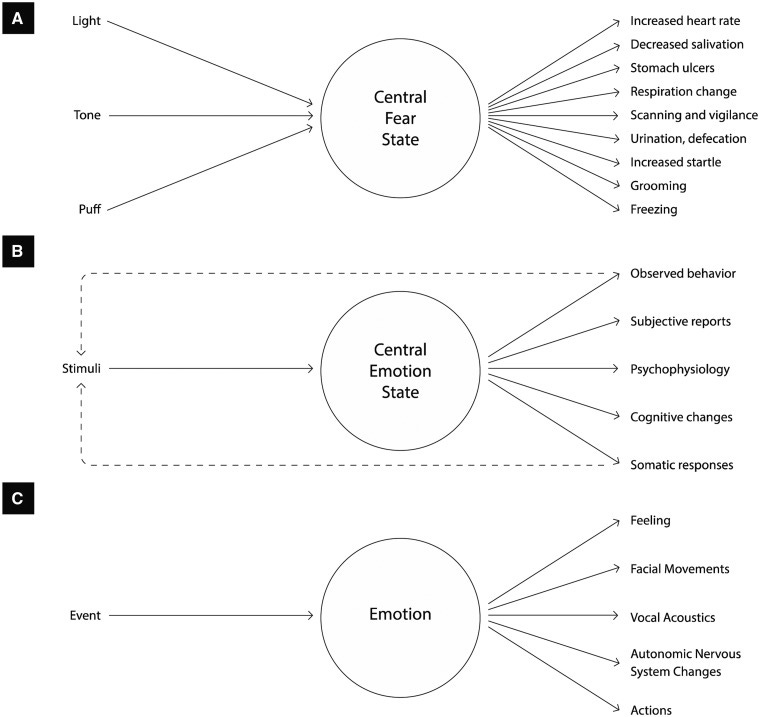
The Predictive Brain Meets Neurotechnology
Predictive coding provides a powerful lens for designing next-generation BCIs — systems that interpret, anticipate, and adapt to neural states rather than merely reading signals.
Detecting Prediction Errors: EEG markers such as MMN and ERN allow real-time detection of cognitive mismatch or performance errors. BCIs leveraging these signatures can adapt interfaces dynamically, adjusting stimuli, difficulty, or feedback loops (Blankertz et al., 2012).
Active Inference Interfaces: In active inference, the brain acts to minimize prediction error, by changing the world or its own model (Friston et al., 2017). BCIs can mirror this principle: instead of passively decoding, they probe the user (through feedback or stimulation) to reduce uncertainty.
Adaptive Motor and Cognitive Systems: Closed-loop neuroprosthetics already exploit predictive mechanisms. Motor-imagery BCIs predict intended movement before muscle activation, while adaptive EEG systems detect lapses in attention or fatigue seconds before performance declines .
Parallels with Artificial Intelligence
Modern AI shares the same core logic: prediction. Large language models, predictive vision systems, and generative agents all minimize “loss” — the digital analogue of prediction error.
But while current AI lacks embodied feedback, biosignal-informed AI closes that loop. When BCIs feed human-state data (EEG, EMG, HRV) into adaptive algorithms, machines gain priors shaped by biology. This convergence of predictive coding and embodied AI may define the next era of human–machine symbiosis
Ethical and Philosophical Considerations
Manipulating priors is powerful and risky. If perception is a controlled hallucination, technology that alters priors effectively alters reality.
Autonomy: Adaptive interfaces must preserve voluntary control, not override it.
Consent: Emotional or perceptual nudging requires explicit awareness and opt-in.
Bias: Predictive systems trained on limited priors risk amplifying societal and cognitive bias.
Neurotechnology must therefore operate with what philosophers call epistemic humility, awareness of the limits of what can or should be changed in the human predictive loop.
Closing Thought
The brain is not a camera capturing the world; it is a composer conducting a symphony of expectation and error.
To build truly human-aware machines, we must learn not only to read the brain’s signals but to understand its predictions.
Call for Research Collaborations: EEG, EMG & Beyond
Nexstem is looking to partner with universities, labs, and researchers exploring EEG, EMG, or multi-biosignal systems. If your work bridges neuroscience and engineering, we’d love to collaborate on the next breakthrough. Reach out: collaboration@nexstem.ai
❤️ Join us on Discord.
Thanks for reading Neurotech Pulse! Subscribe for free to receive new posts.